Showing posts with label myth. Show all posts

Saturday, May 7, 2016

Samson's height

Tyrannosaurus is 4 meters tall, blah blah blah. That's what most random online sources tall you.

But that figure is total nonsense, a fantasy with no basis in reality. In reality, T. rex's hip height levels out at around ~3.5 meters, give or take, whether the T. rex be Stan to CM 9380 to Sue.

Tyrannosaurus rex skeletal reconstructions by Scott Hartman. I do not own anything from this.


But is Sue the tallest Tyrannosaurus? Some, well, sources (including Wikipedia) states that Samson is the tallest known T. rex at an alleged ~4.6 meters in hip height. This is a mounted skeleton of Samson, with a woman standing next to the skeleton for scale:

Samson's mounted skeleton, mostly speculative though

And here's Samson's known bones and measurements, from the Theropod Database:

"skull (1.4 m), mandibles (dentary 870 mm), twenty-two teeth, nine cervical vertebrae, two cervical ribs, seven dorsal vertebrae, ten dorsal ribs, seventeen caudal vertebrae, four chevrons, femora (1.295 m), tibial fragments, fibula, metatarsal II (610 mm), metatarsal III, metatarsal IV (635 mm), ten pedal phalanges"

Samson's mounted skeleton measured
 If Samson were to be ~4.6 meters tall at the hips, then the woman standing next to it would have to be around ~1.99 meters tall. Although not impossible, women, or for that matter, humans, of that height are rare, and they tend to have more elongated builds. Assuming that this woman is almost 2 meters tall isn't the most parsimonius option. Also, this would make Samson's femur around ~1.61 meters long, which is a whopping ~24.32% longer than the measurement from the Theropod Database.

Assuming an average height of ~1.65 meters for the woman, Samson would be around ~3.8 meters tall at the hips. It's much lower than the exaggerated ~4.6 meter figure, but it's still a bit too high, as this would make Samson's femur around ~1.33 meters long, longer than the actual femur measurement.

Taking the femur length of ~1.295 meters, this yields a total hip height of ~3.7 meters for Samson (while the woman would be around ~1.6 meters tall). This is quite tall for a Tyrannosaurus, but not so tall as to be implausible.

Taller than Sue? Maybe, if that ilium, which isn't actually known from Samson, was actually reconstructed accurately. Why is the front part of that ilium so much higher than the rear portion, with a steep transition closer to the rear portion? That's not the case with Tyrannosaurus ilia.

Tyrannosaurus rex specimen AMNH 5027. Notice the ilium shape.


Sue and Stan skeletal reconstructions by Scott Hartman. Notice their ilium shape.

We'll see more about Samson in the next post.

Thursday, August 8, 2013

Spinosaurus has no sail


There are popular mainstream beliefs that are just plain wrong.

One of them, is the issue I shall address: Sailbacked Spinosaurs.


Spinosaurus has traditionally been depicted with a sail. Jurassic Park 3 is also to blame for this as well.

But just because it's depicted as such, doesn't mean it's true. In fact, it's in this case, it's pretty wrong.

The comparisons used to give Spinosaurus a sail are Dimetrodon and Edaphosaurus, they even literally put a Dimetrodon sail on a spinosaurid's body in some reconstructions, like the one shown below:

Spinosaurus does NOT look like this!

Whoever made that depiction, obviously did not look at, or completely ignored, the fossils.


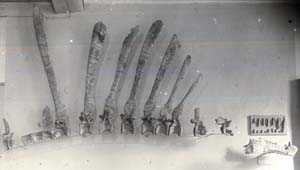
Spinosaurus holotype IPHG 1912. Note the broadness of the spines, and the fact that they look nothing like that of Dimetrodon.


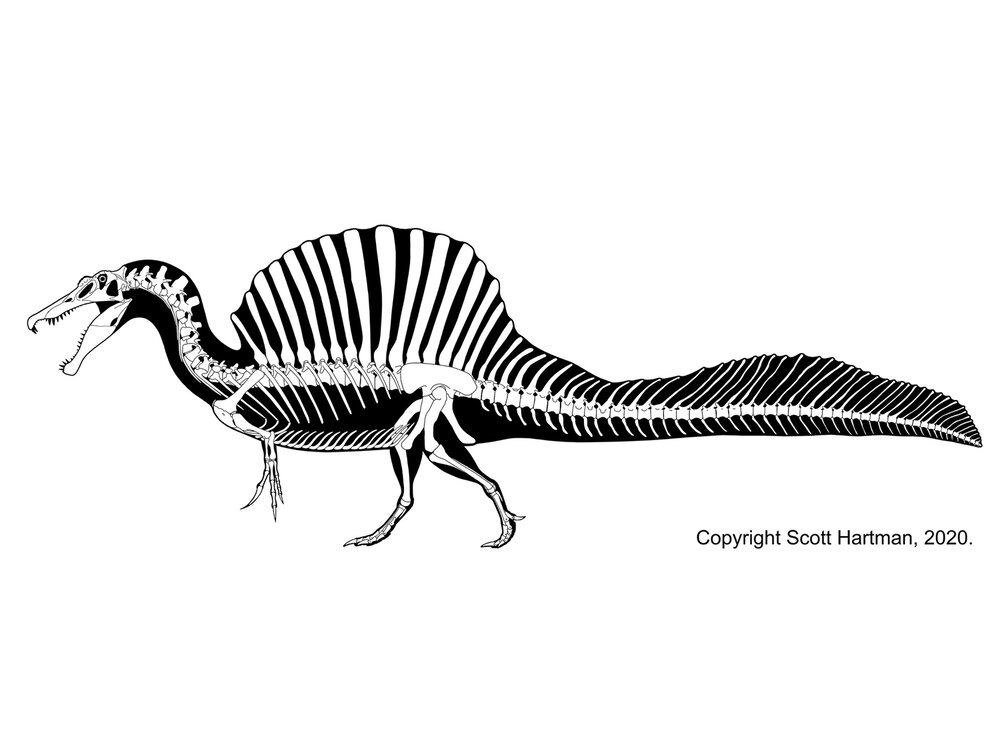
By looking at the fossils, it's pretty obvious that Spinosaurus' neural spines looked nothing like a sailback's. In fact, Spinosaurus spines actually resemble bison and chameleon spines more(not perfect matches though) than those pathetic thin rods.


Spinosaurus skeletal reconstruction by Scott Hartman. Note the broadness and the spacing of the spines. There's little space between each neural spine. Image only used for illustration. I obviously have no claims towards this image.
Bison skeleton. The tall elongated spines support a heavy hump. The spines are close together, and are broad, like Spinosaurus. However, the bison's neural spines are thicker in frontal view, and that's where the chameleon comes in.
Chamaeleo melleri, a ridgebacked chameleon. it's spines also compare to Spinosaurus', but isn't as elongated, and the chameleon's spines are spaced farther from each other than that of bison and Spinosaurus.


Chamaleo melleri, in the flesh. There is no clear distinction between ridge and back.

The dorsal structure of Spinosaurus seems to possess attributes of both bison and chameleon spines. It is therefore likely that Spinosaurus had a ridge. It would have looked like a vertically-elongated triangle with a somewhat thin and rounded top in cross-section.

The neural spines of sailbacks only have to support itself and a vascular network. They can, and do get thinner distally, from all directions. This is not the case with Spinosaurus.

No suitable comparison can give Spinosaurus a skin sail.

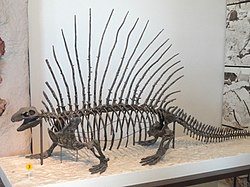
Oh, and here's the Dimetrodon and Edaphosaurus stuff:
Dimetrodon skeleton. Note the thin rod-like spines, which look absolutely NOTHING like the ones found in Spinosaurus.
Edaphosaurus skeleton. Again, a total lack of resemblance to the spines of Spinosaurus.

Those sailbacks have spines which, aside from being long and elongated, have nothing in common with that of Spinosaurus!

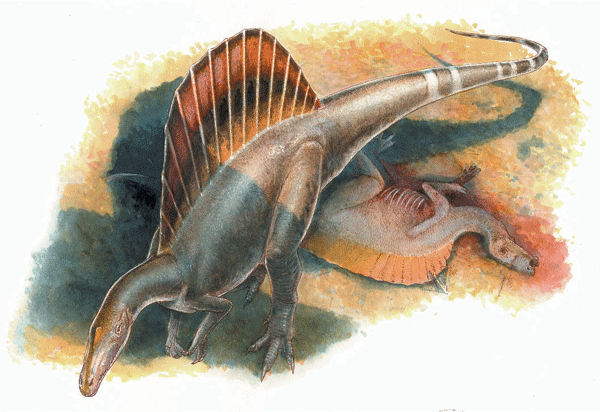
In the top image, I have photoshopped a Spinosaurus restoration, to incorporate the more likely dorsal structures. The same has been done with the Ouranosaurus carcass. Here is the original, and very wrong, image.

Whether that structure is muscle or fat remains is still debatable.

With this, we can say, that a Dimetrodon-backed Spinosaurus is silliness.

If it had a sail, why would it evolve broad spines, when thin rods could have done the job?

Simple answer: It did NOT evolve a sail. Animals do not waste energy developing useless structures.

Thursday, July 11, 2013

How large is UCMP 137538, really?

Many of you who are interested in dinosaurs, may have seen people in forums and youtube who fuzz over the legend of the "14-15 meter Tyrannosaurus", and refer to the specimen "UCMP 137538".

UCMP 137538 is known from a single 13-centimeter long pedal phalanx, which has been assumed to be a left pedal phalanx from comparisons with FMNH PR2081. That is a weak assumption, as the bone looks quite different from that of FMNH PR2081.

For starters, it may not even be a tyrannosaurid. It could have been a gigantic therizinosaur, since a herbivorous lifestyle isn't limited by the constraints of a carnivorous one, such as the need to run down prey. If you read the paper about UCMP 137538, you will see that the only real diagnosis done is the one assigning it as a theropod.

It's assignment to Tyrannosaurus is based on nothing but size and location, both of which are weak arguments for assigning isolated fossils to specific genera/species. It's also partly based on the assumption that Tyrannosaurus is the only large theropod living at North America at the Maastrichtian age, which is quite an almost-baseless assumption, considering that the vast majority of the dinosaurs are very likely undiscovered.

It's placement within the foot is also uncertain, the paper bases it's placement on nothing but superficial appearance.


Then how large would it be?


Answer: Completely unknown.


The problem is, it's just an isolated toe bone. Even the enigmatic Amphicoelias fragillimus is known from better remains(A D9/D10 vertebra).

The giant sizes come from scaling it up from FMNH PR2081, and the naive fanboys seemingly only scale from that specimen. FMNH PR2081 isn't the only tyrannosaur specimen however. And Tyrannosaurus isn't the only tyrannosaur. For all we know, UCMP 137538 may actually be a non-Tyrannosaurus tyrannosauroid.

Even IF it was a Tyrannosaurus or a very similar genus, you should still stay away from those 14+ meter calculations. Tyrannosaurus specimens can show quite a lot of variation.

BHI 3033(~10.9 meters, probably around 6 tonnes?), has toe bones that come close in size to that of FMNH PR2081. Not to mention that with pathogeny, digit bones can vary greatly even within individuals.

It is entirely possible that UCMP 137538 may actually be smaller than FMNH PR2081(~12.3 meters, ~8 tonnes).