Argentinosaurus is commonly considered to be the largest dinosaur.
If not it, some giant Cretaceous gigapod such as Puertasaurus is given the crown. Nowadays, it seems that whether the question of what is the largest known dinosaur is brought up, most people would answer with something within Titanosauria and from the Cretaceous period. In 2014, the bones of an unnamed gigantic titanosaur, with a femur requiring three forklift pallets to hold, has been unearthed and a skeletal mount of it, restored with speculative portions, has been placed on display.
But do the Cretaceous titanosaurs really hold the crown?
Likely not so.
A few brachiosaurs such as Breviparopus and Ultrasauripus possibly rival or exceed the sizes of supergiant titanosaurs like Argentinosaurus or Puertasaurus.
Even the good old Brachiosaurus altithorax could probably reach Argentinosaurus-esque sizes, as a large specimen (~2.42-meter humerus) in the BYU collections (Paul, 1988) suggests. This B. altithorax specimen probably massed over 70 tonnes, vindicating Walking With Dinosaurs' Brachiosaurus mass figure.
The giant Oklahoma Apatosaurus ajax specimens, which probably massed between ~50-60 tonnes or so, aren't even fully grown, they lack cervical rib fusion, which corresponds to roughly ~80% of fully-grown adult dimensions in Diplodocus and Giraffatitan. It's probable that Apatosaurus ajax adults reached the 100-tonne mark, surpassing Argentinosaurus and possibly rivaling Puertasaurus in size.
But how about something larger than even them? It turns out that such creatures probably existed. Three are known, but one is known only from a footprint (~1.5-meter wide footprint in Plagne, France). That'll be a story for another time. Another is known from an incomplete sacrum ("Brachiosaurus" nougaredi from North Africa), which will also be a story for another time.
One day, in 1878, during the Bone Wars, Edward Drinker Cope discovered the bones of a sauropod dinosaur in the Morrison Formation. He named the animal Amphicoelias, meaning "double hollow", "amphi" meaning "both sides" and "coelias" from "koilos", meaning "hollow". The binomial name was Amphicoelias altus, meaning "high double hollow", "altus" meaning "high" or "elevated".
It was far from complete. Here's what Cope found of it, along with additional elements assigned later on such as a shoulder girdle and an ulna:
More recently, analysis of the scapula material revealed a camarasaurian nature, while the ulna, being referred to A. altus largely based on disagreement with Camarasaurus and the other sauropods in Cope's collection, is probably a candidate for exclusion.
From Tschopp and Mateus, 2015:
"The holotype of Amphicoelias altus originally included a tooth, two
dorsal vertebrae, a pubis, and a femur (Cope, 1877a). A scapula,
coracoid, and an ulna were later provisionally referred to the specimen
(Osborn & Mook, 1921). However, the strongly expanded distal end of
the scapula, and the relatively deep notch anterior to the glenoid on
the coracoid actually resemble more Camarasaurus than any diplodocid
(McIntosh, 1990b; E Tschopp, pers. obs., 2011). The same accounts for
the single tooth stored at AMNH (Osborn & Mook, 1921). The tooth has
already been excluded from scores of A. altus in recent phylogenetic
analyses (Whitlock, 2011a; Mannion et al., 2012), which is followed
here. Mannion et al. (2012) furthermore excluded the referred forelimb
elements. Given that personal observations confirmed the rather
camarasaurid than diplodocid morphology of the scapula and coracoid, but
not particularly the ulna, two different preliminary phylogenetic
analyses were performed with a reduced (excluding the tooth, the scapula
and the coracoid, but including the ulna) and the extended holotype
Amphicoelias altus OTU (including all referred elements other than the
tooth). Because both analyses yielded the same position for the
specimens, the reduced holotype was preferred in the final analysis. The
risk of adding dubious information from potentially wrongly referred
material was thus circumvented. More detailed analysis is needed in
order to refine these assignments."
Removing the referred shoulder girdle and ulna, this is what's left from the holotype, the original specimen that Cope found of it:
Not that much. But it's enough to give us a bit of an idea about the animal's size and proportions.
Now, this doesn't seem like an animal anywhere near Argentinosaurus size, let alone larger. But here's the thing - it's not alone. It had a cousin that was much, much larger.
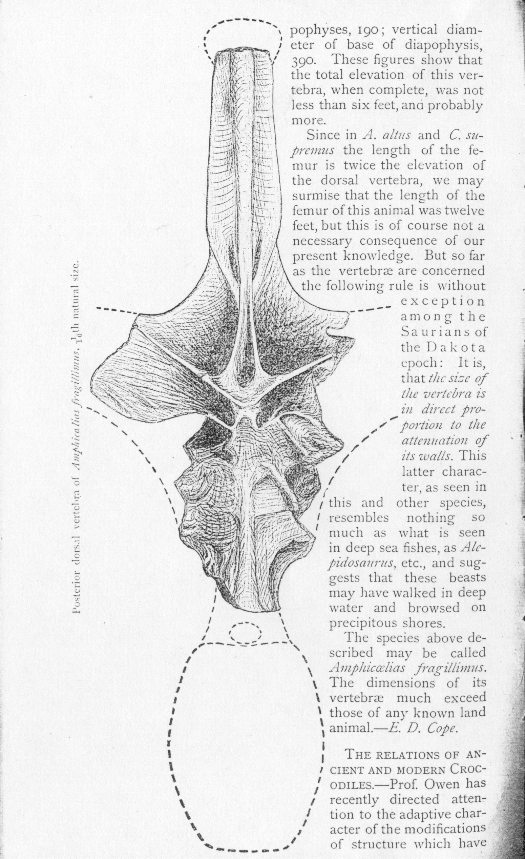
Later in 1878, Cope, back in the Morrison, found a huge bone. A fragmentary neural arch from a posterior dorsal, around 1.5 meters tall. A single bone fragment, from a bone that isn't really very big by itself compared to the rest of the body, as tall as a person. Whatever animal bore this bone must have been truly immense in life.
This gigantic bone was assigned by Cope to a new species, Amphicoelias fragillimus, meaning "fragile double hollow".
Had this fossil survived to the present, Giraffatitan would have never taken fame as the "largest known dinosaur" for decades, and Tyrannosaurus would have never been called "the king of the dinosaurs". Argentinosaurus would not have had the fame for it's size that it has now, and the Chubut monster titanosaur wouldn't have looked so impressive. But this was not to be.
The bone was in very bad condition and was crumbling. It's condition deteriorated to the point that it was soon discarded, possibly by Cope himself. The fragility that gave it it's name, was the cause of it's destruction.
The legendary giant of the Jurassic, was lost, and then forgotten by almost all but a few. Ok, this animal has gained a little popularity recently, but is still very obscure. The big reason for this recent gain in popularity is Carpenter's 2006 paper, which attempts to estimate size based on the smaller A. altus dorsal and Diplodocus.
He arrives at a total last dorsal height of ~2.7 meters, a total length of ~58 meters and a mass of ~122.4 tonnes, approximately ~30 or so tonnes more massive than the average blue whale, or probably 50-70 tonnes more than Argentinosaurus.
However, his reconstruction depicts the animal as an upscaled clone of Diplodocus. Amphicoelias' actual known proportions are significantly different from
those of Diplodocus. I will compare their proportions bone-by-bone in
the next post.